
Open-Air Exhibition: “Europe—An Old Idea in a New Form”
The development of German democracy is closely intertwined with European history. Ideas, movements, and institutions that have shaped Germany are part of a pan-European process that began long before the founding of the European Union (EU). This process includes negative experiences, including violence and exclusion. Yet Europe has always been a space for exchange, where people, ideas, and cultural trends crossed borders and shaped political systems.
How did history in Germany become European—and how has Germany shaped Europe?
Even in pre-democratic times, European peace treaties such as the Peace of Westphalia in 1648 and the Congress of Vienna in 1815 shaped the European continent. The ideas of humanism and the Enlightenment had a lasting influence on the German national movement. Thus, the Revolution of 1848–49 was part of a European uprising that demanded civil liberties and national self-determination. After World War I, the first German democracy was established in 1919. Democratic German politicians promoted European understanding and advocated for cooperation within the League of Nations. These efforts paved the way for later European unification processes. After World War II, Western European cooperation became a cornerstone of West German foreign policy. The end of the Cold War and the reunification of Germany in 1990 marked the beginning of a new phase of European expansion. In 1992, what is now Article 23—the so-called “Europe Article”—was incorporated into the Basic Law: “With a view to establishing a united Europe, the Federal Republic of Germany shall participate in the development of the European Union that is committed to democratic, social and federal principles, to the rule of law and to the principle of subsidiarity and that guarantees a level of protection of basic rights essentially comparable to that afforded by this Basic Law.” The European Union is a unique project for peace and democracy based on the principles of unity in diversity, the rule of law, and civil liberties. Having emerged from an economic union, it today sovereignly unites.
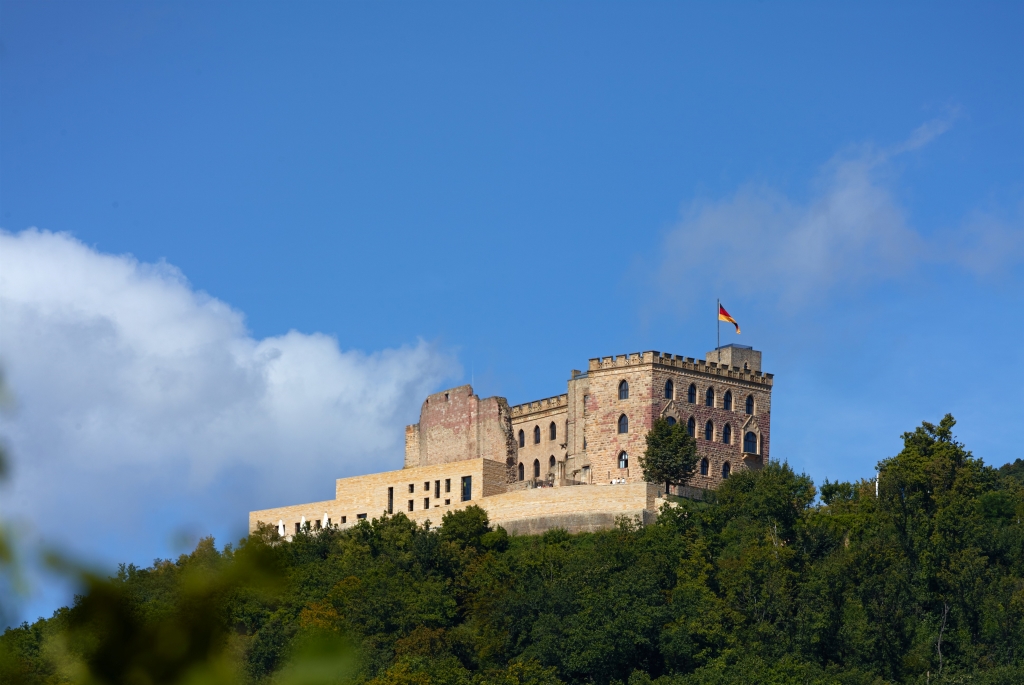
Hambach Castle, Neustadt an der Weinstraße, Rhineland-Palatinate, Germany. In the early 19th century, a desire to establish independent nation-states grew across Europe. There was widespread discontent due to the repressive measures of the authorities and economic and social hardship. The German unification movement found expression in two major rallies: the Wartburg Festival of 1817 and the Hambach Festival of 1832. At the Wartburg Festival, nearly 500 students from all over Germany marched to Wartburg Castle to demonstrate for German unity and a common constitution guaranteeing fundamental rights. The goal was a unified nation-state, in part to be able to hold its own against other states. The approximately 25,000 participants in the Hambach Festival, on the other hand, came not only from German territories but also from Poland and France—countries where resistance to restorationist rule was also taking place. They, too, demanded a united and democratic nation-state. However, this was to be established within a Europe bound by solidarity.
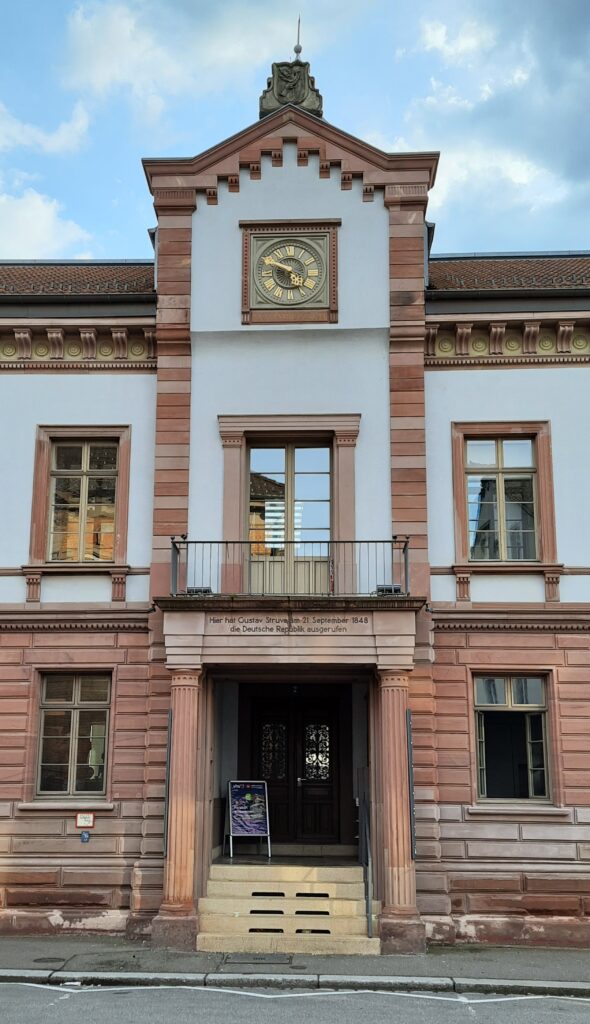
Old Town Hall, Lörrach, Baden-Württemberg, Germany. In the 19th century, dissatisfaction with the authorities also gave rise to bourgeois aspirations and the idea of a democratic bourgeois republic in Germany. An attempt to implement this took place in Baden-Württemberg: On September 21, 1848, the Baden revolutionary Gustav Struve proclaimed the German Republic from the Old Town Hall, with Lörrach to serve as its provisional seat of government. The city, located in the tri-border region of France, Switzerland, and Germany, was an important launching pad for democratic movements. Its geographical location facilitated cross-border revolutionary activities: Struve took advantage of this situation by preparing his march on Lörrach from Basel. Even though the wider revolution and his German Republic ultimately failed, the Lörrach uprising was an important milestone in the democratization process of southwestern Germany.
Europe of Movements
Democracy is built by people who stand up for freedom, equality, and justice. Movements emerge when many people fight together for a cause—they bring people together and give democracy its vibrant dynamism. From the Middle Ages to the present day, social movements and personal encounters have driven European integration forward. They created a network that repeatedly transcended national boundaries and shaped European democracy through cross-border exchange.
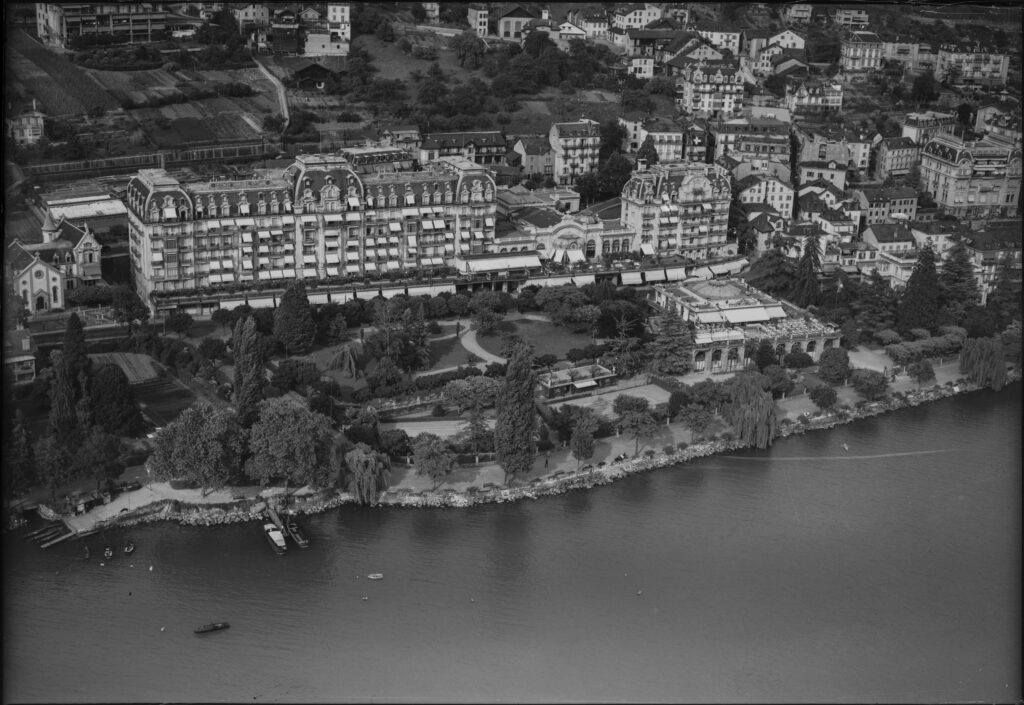
Hotel Montreux-Palace, Montreux, Switzerland. The Montreux Conference in August 1947 brought together some 400 delegates from the Union of European Federalists (UEF) representing 16 countries. Their goal was to promote European cooperation and develop the idea of a European federation. They discussed concepts such as the “Estates General of Europe” and laid the groundwork for the later founding of the Council of Europe. The participants called for political, economic, and cultural cooperation to ensure peace and stability in Europe. The UEF emerged from various national associations that had existed since the 1920s.
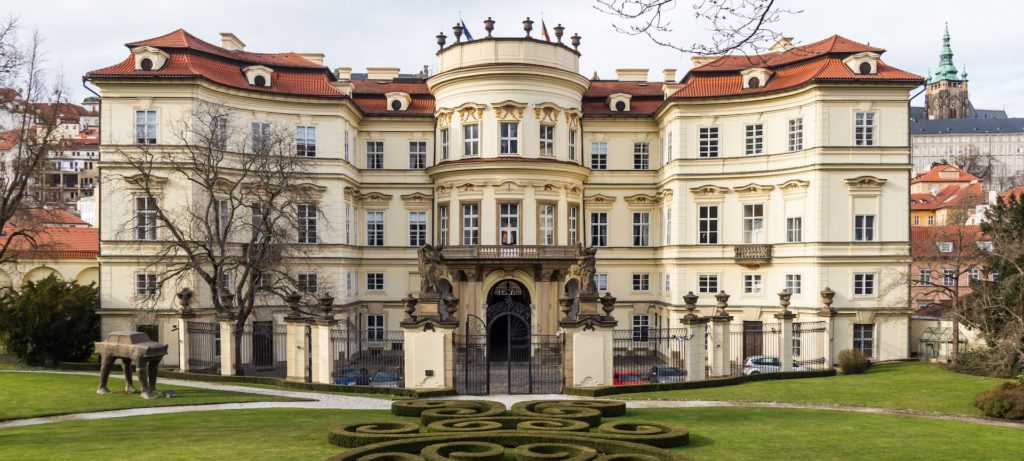
West German Embassy, Prague, Czech Republic. In the fall of 1989, the West German Embassy in Prague became the symbolic focal point of the freedom movement in Europe. Thousands of citizens of the GDR had sought refuge on the embassy grounds since August 1989. At times, as many as 4,000 people were staying there. On September 30, Hans-Dietrich Genscher announced from the embassy balcony that these people would be allowed to leave for West Germany—“We have come to tell you that today your departure…” He couldn’t get any further; the rest of the sentence was drowned out by cheers. At the urging of Czechoslovakia, the SED Politburo had agreed to allow direct departure to West Germany without further formalities. The wave of escapes, which began with the occupation of the embassy grounds in the summer, reached its peak here and opened the way for many to a life free from state control.
Heiligendamm, Mecklenburg-Western Pomerania, Germany. During the 2006 G8 summit, large-scale protests against globalization took place. The protesters expressed their dissatisfaction with the direction the EU was taking. Instead of a “Europe of corporations and bureaucrats,” they called for a more democratic, social, and environmentally friendly Europe. The European Court of Human Rights subsequently reprimanded Germany for failing to uphold human rights conventions in its handling of the protesters. The protests intensified the public debate on the legitimacy of supranational institutions and increased pressure on policymakers to take citizens’ concerns seriously. They made it clear that acceptance of international decisions also depends on civic participation and political transparency. This sparked critical debates about the role of civil society in the future of Europe.
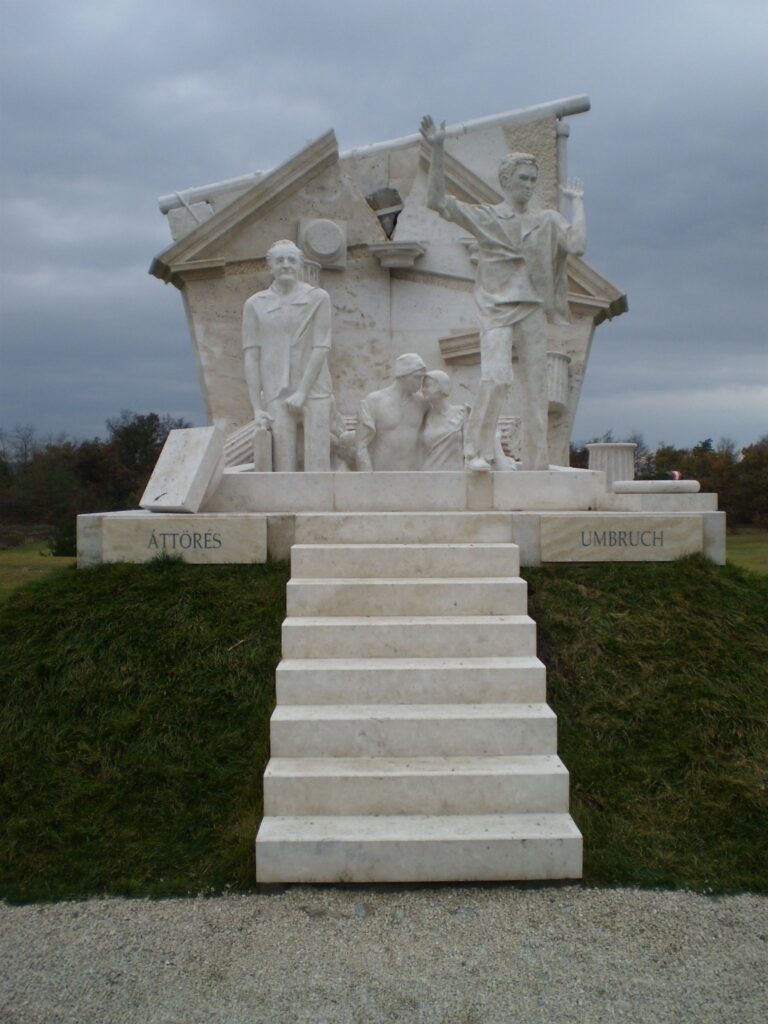
Sopron, Hungary. Originally, a purely symbolic opening of the border gate for a few hours had been planned. But on August 19, 1989, the Pan-European Breakfast near the Hungarian city of Sopron turned into a historic event when 600 East German citizens fled to Austria. The Hungarian government tolerated this first “small” border opening to test the Soviet Union’s reaction—which failed to materialize. This emboldened Hungarian reformers to press ahead with dismantling the border, which ultimately led to the complete opening of the Hungarian-Austrian border one month later. Thus, the Pan-European Picnic sent a signal for the impending political reorganization of Europe.
Europe of Institutions
From the first peace treaties to the founding of the European Union, it was political initiatives and treaties that shaped Europe into a community based on the rule of law and shared values. Today, Europe is a complex institutional framework that facilitates political and economic cooperation and safeguards rights. However, it is not just a success story: European institutions can appear inflexible and out of touch with citizens, and their policy of isolation from the outside world and internal integration draw criticism.
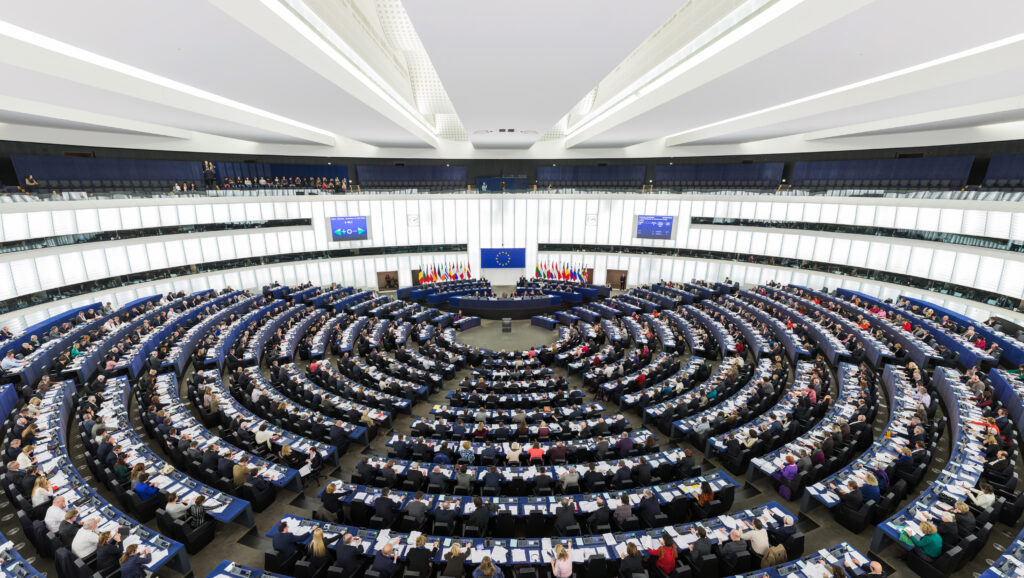
European Parliament, Strasbourg, France. The European Parliament in Strasbourg is the world’s first transnational parliament and the result of a decades-long process of integration. It oversees the European Commission, passes laws, and approves the EU budget. Its roots date back to 1952, when the advisory “Common Assembly” of the European Coal and Steel Community was established. With the founding of the European Economic Community and the European Atomic Energy Community, the body was expanded to become the “European Parliamentary Assembly” and renamed the “European Parliament” in 1962. Since the introduction of direct elections in 1979, it has been a democratically legitimate body. Today, the European Parliament is a central institution of the EU. Its development reflects Europe’s transformation—from an economic community to a community of values and law, in which democratic participation is guaranteed at the European level.
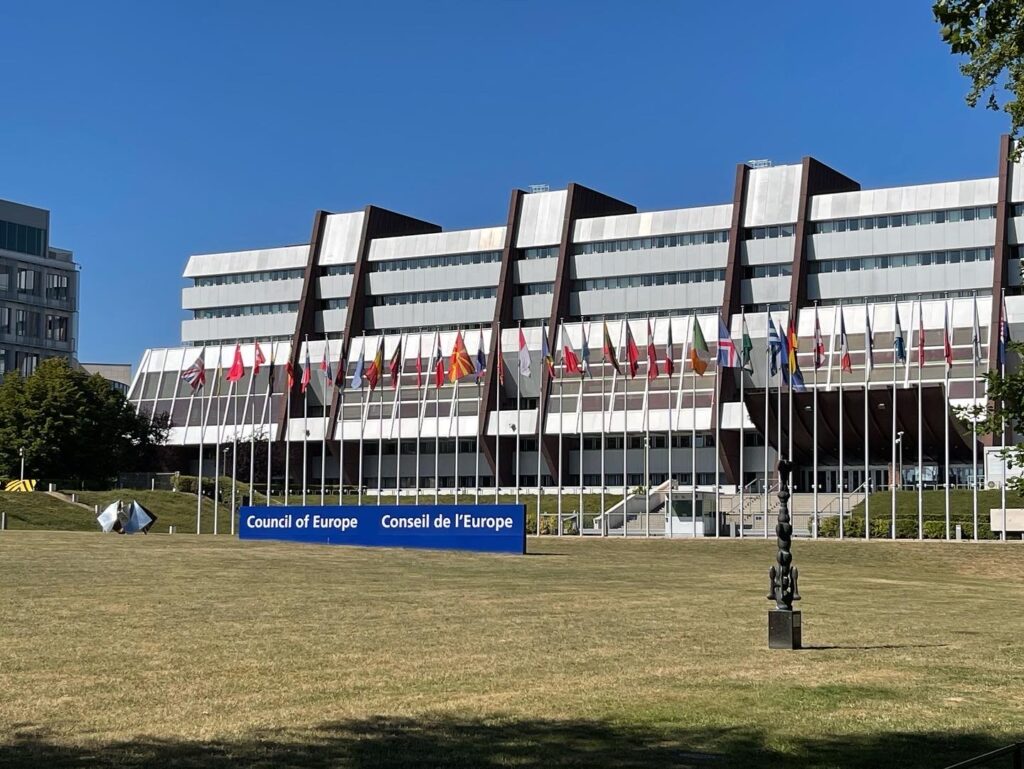
Palais de l’Europe, Strasbourg, France. The Council of Europe was founded on May 5, 1949, in London by ten European countries: Belgium, Denmark, France, Ireland, Italy, Luxembourg, the Netherlands, Norway, Sweden, and the United Kingdom. The goal was to secure peace by promoting democracy, human rights, and the rule of law. The Council of Europe was of crucial importance to German politics: it provided a framework for reintegrating Germany into a cooperative European structure after World War II. The Federal Republic of Germany joined the Council of Europe in 1950 and used it as a platform for rebuilding diplomatic relations.
The Europapalast has been the seat of the Council of Europe since 1977. Until then, the Council of Europe met in its predecessor building on the same site, the “Maison de l’Europe.”
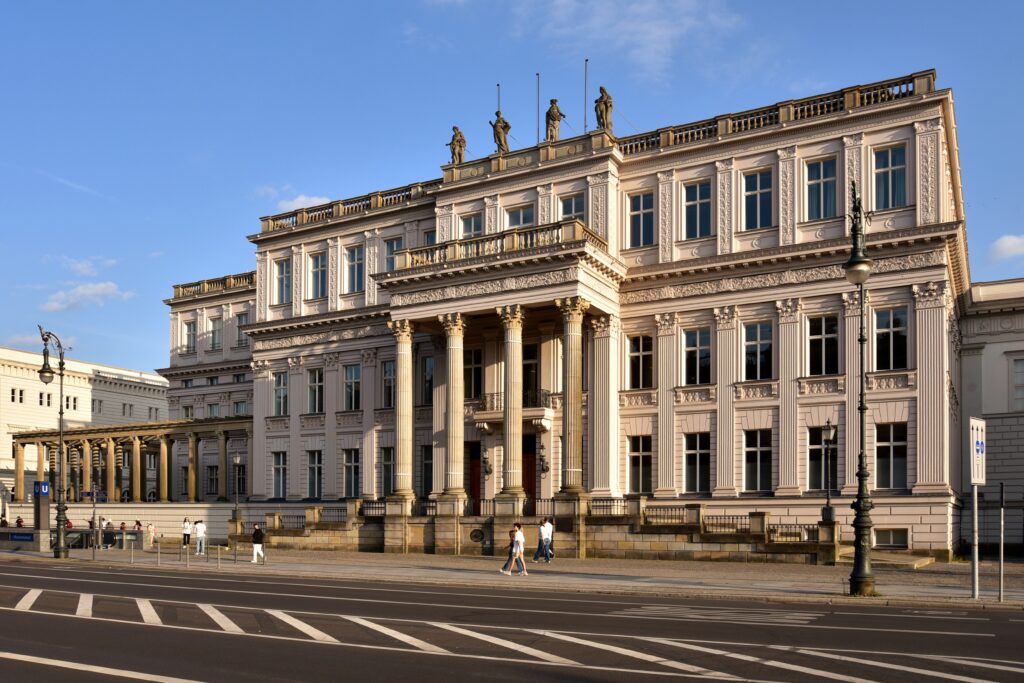
Kronprinzenpalais, Berlin, Germany. The process of German reunification also had a European dimension: On October 3, 1990, the new federal states, which had previously belonged to the GDR, became part of the FRG. The FRG was already a member of the European Community (EC), the predecessor of the EU. With the GDR’s accession to the FRG, the entire territory of Germany automatically became part of the EC. This accession altered the economic and political balance of power within the EC and marked its first eastward expansion. On the one hand, it entailed immense demands for adjustment; on the other hand, it also offered new opportunities and support for the people and businesses in eastern Germany.
The “Treaty on the Establishment of German Unity” was signed on August 31, 1990, at the Kronprinzenpalais in East Berlin by the chief negotiators Wolfgang Schäuble, representing the government of the FRG, and Günther Krause, representing the GDR government.
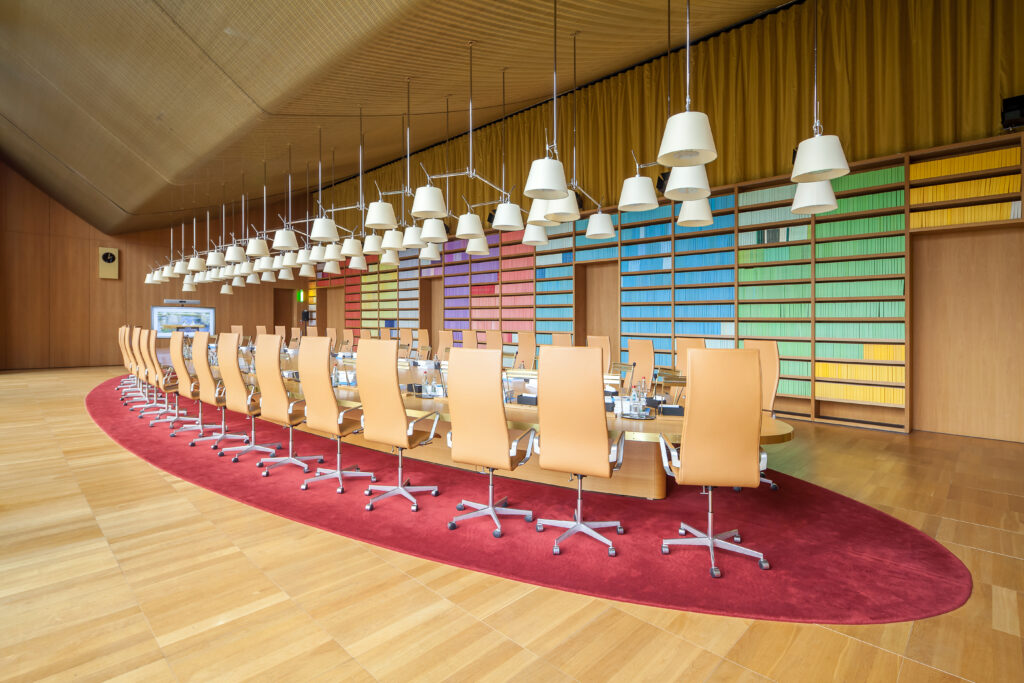
Palais de la Cour de Justice, Luxembourg City, Luxembourg. The Court of Justice of the European Union (CJEU) was established in 1952 as part of the European Coal and Steel Community. It is the EU’s highest court and plays a central role in ensuring the uniform application and interpretation of EU law. The success of the EU depends largely on the implementation of this law, which contributes to legal integration independently of intergovernmental treaties. After World War II, the CJEU was instrumental in restoring confidence in international legal structures and integrating Germany into the European legal community.
The Grand Conference Room of the CJEU. The back wall of the room is adorned with the Court’s collected decisions.
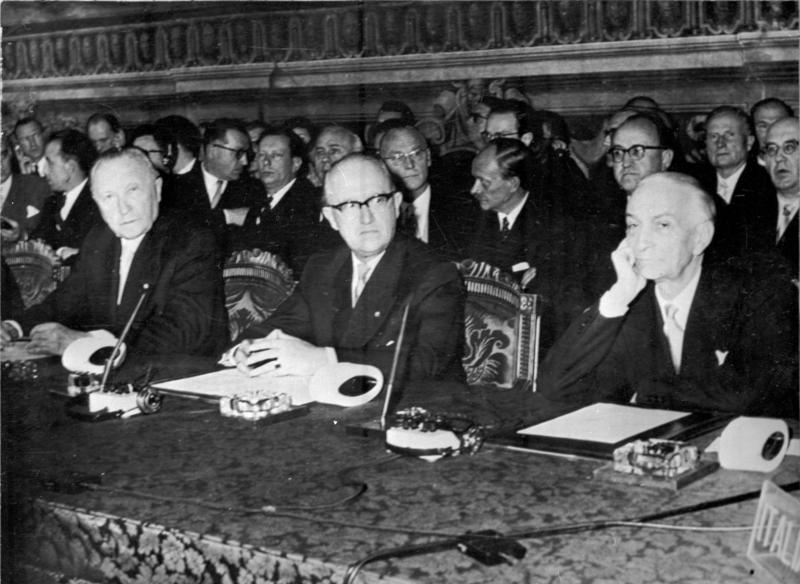
Palazzo dei Conservatori, Rome, Italy. On March 25, 1957, Rome became the birthplace of the European Economic Community (EEC) and the European Atomic Energy Community (Euratom). The six founding member states—Belgium, Germany, France, Italy, Luxembourg, and the Netherlands—laid the foundation for deeper integration of the European market and closer cooperation with the “Treaties of Rome.” Through intra-German trade, the GDR had indirect access to the EEC. It was to the GDR’s advantage that, from the West’s perspective, the intra-German border was not considered a national border and was therefore not subject to customs duties.
Chancellor Adenauer, who signed on behalf of the FRG, State Secretary Hallstein, and Italian Prime Minister Antonio Segni.
Bildquellen
- Hambacher Schloss: © Stiftung Hambacher Schloss, Foto: Stefan Müller
- Altes Rathaus Lörrach: Zieglhar, CC BY-SA 4.0
- Hôtel Le Montreux Palace: Werner Friedli, CC BY-SA 4.0;
- Botschaft der Bundesrepublik Deutschland Prag, Rückseite mit Garten: Raimond Spekking, Wikimedia Commons, CC BY-SA 4.0.
- Denkmal zum Paneuropäischem Picknick: Kaboldy, CC BY-SA 3.0
- Europäisches Parlament: Diliff, CC BY-SA 3.0
- Palais de l’Europe: Le Commissaire, CC BY-SA 4.0
- Kronprinzenpalais (Berlin): Bahnfrend, CC BY-SA 4.0
- Palais de la Cour de Justice: Bundesarchiv, Bild 183-1990-0617-018 / Franke, Klaus / CC-BY-SA 3.0, CC BY-SA 3.0 DE
- Römische Verträge: Bundesarchiv, Bild 183-45653-0001, CC BY-SA 3.0